
If you need to extract data from Facebook Marketplace at scale, you need the right Facebook Marketplace scraper, one that can handle dynamic rendering, anti-bot systems, and login walls. In 2026, the platform hosts millions of daily listings across real estate, vehicles, and consumer goods, making it one of the richest sources of hyper-local commerce data.
Whether you are a reseller seeking low-cost items to resell, a dealership tracking vehicle pricing trends, or a real estate agent investigating rental listings, automating the extraction of Facebook Marketplace data is the only way to remain competitive. But how can you manage the complicated landscape of dynamic classes, IP prohibitions, and login barriers? How can you ensure that your scraping Facebook Marketplace efforts provide clean, organized data without jeopardizing your account?
⚠️ Before You Use Any Scraping Tool
This article compares tools for extracting publicly listed Facebook Marketplace data for legitimate research and business intelligence (price monitoring, market research, automotive and real estate analytics).
Facebook Marketplace scraping exists in a legal gray zone: public listings are generally accessible, but Meta’s Terms of Service prohibit automated collection. Before using any tool listed below:
- Check Meta’s Commerce API first — it’s the only fully ToS-compliant path for commerce data
- Only target public listings — never scrape private messages, buyer-seller conversations, or non-public seller data
- Exclude personal identifiers where they’re not essential to your analysis
- Comply with local data protection laws (GDPR, CCPA, and equivalents)
- Consult a lawyer before deploying any of these tools commercially
The tools described are evaluated on technical merit. Legal compliance is your responsibility.
Quick Answer
You need a dedicated, specialized Facebook Marketplace scraper tool to handle the difficulties of dynamic classes and anti-bot systems while keeping your data clean. The article compares five of the best tools. Chat4Data stands out in our testing as the most beginner-friendly option because it combines the ease of use of a browser extension with AI-powered data structuring, no coding required.
By the end of the article, you will get a good grasp of:
- Why scraping Facebook Marketplace is a critical business strategy?
- Comparison of the top 5 tools available in 2026
- How to choose the right tool for your specific data needs
Why You Need a Facebook Marketplace Scraper?
Like any marketplace, a Facebook Marketplace scraper is a strategic asset that transforms raw listings into actionable business intelligence. Unlike standard e-commerce sites like Amazon, Facebook Marketplace offers hyper-local data that reflects the immediate supply and demand of specific geographic areas.
Key applications of scraping the Facebook marketplace:
- Arbitrage and Price Monitoring: Rapidly track real-time listings to automatically spot and secure underpriced items (like antiques or video games) before manual users. Monitoring prices over time improves negotiation and competitive pricing for your own sales.
- Automotive and Real Estate Lead Generation: Dealerships and real estate firms use scraped data from the “Property for Rent” and “Vehicles” categories to find private sellers. A scraper extracts key data (seller names, vehicle/property details, contact info) to feed a continuous stream of leads into a CRM.
- Hyper-Local Market Research: Identify local microtrends, regional preferences, saturation levels, and pricing discrepancies often missed by broad market statistics.
- Training AI Models: The Marketplace is a massive source of training data for visual search engines and pricing algorithms. Scraping gives you millions of image-text pairs (product photos with user descriptions and prices). These are very important for teaching computer vision models how to see things in real-world, unpolished settings. Using Python for Facebook scraping is a popular practice.
Before Choosing a Tool: Legal and Compliance Considerations
Marketplace data is commercially valuable precisely because it’s hyper-local and fresh — but that same value means Meta has strong incentives to protect it. Before picking any tool below, understand what you’re agreeing to.
Facebook’s Terms Position on Marketplace
Meta’s Terms of Service prohibit automated data collection across all products, including Marketplace. Violations can result in:
- Account suspension or permanent ban (contractual)
- Civil suits for breach of contract and tortious interference (Meta has filed such suits)
- Potential Computer Fraud and Abuse Act (CFAA) exposure if you circumvent technical access controls
What Courts Have Said
The landmark case hiQ Labs v. LinkedIn (9th Circuit, 2019; Supreme Court remand, 2022) suggested that scraping publicly accessible data likely does not violate the CFAA — but this ruling is narrow and applies specifically to US federal computer-fraud law. It does not:
- Shield you from breach-of-contract claims under Meta’s ToS
- Apply to scraping behind a login wall
- Override GDPR, CCPA, or other data protection laws
Marketplace-Specific Risk Factors
Marketplace data includes personally identifiable information by nature — seller names, photos, approximate locations, phone numbers in listings. This means:
- GDPR applies if any data subject is in the EU — you need a lawful basis under Article 6
- CCPA applies if you process data about California residents at scale
- Anti-spam laws (CAN-SPAM, CASL) apply if you contact sellers from scraped contact data
Safer Use Patterns
These practices reduce both legal and account-ban risk:
- Scrape only aggregate market data (prices, categories, volumes), not individual seller PII
- If you need seller contact info, collect it per-listing as a human would — don’t bulk-harvest
- Do not build products that resell raw Marketplace listings
- Respect Meta’s robots.txt even though it’s not strictly binding
- Throttle requests to human-like speeds
When in Doubt
Use Meta’s official Commerce API or Marketing API if your use case supports them. When they don’t, document your legitimate business interest, minimize data collection, and consult counsel before scaling up.
Top 5 Facebook Marketplace Scraper Tools in 2026
I put tools on this list in order of importance based on three main factors: how well they can get around Facebook’s anti-bot measures, how easy they are to learn (I prefer tools that are easy for non-coders to use), and how cost-effective they are for long-term use. I want solutions that deliver clean, organized data without requiring extensive manual work or deep developer knowledge. These solutions should be a reliable link between technical complexity and useful business insights.
The “Personal rating” is my personal opinion based on my experience using the tools presented. Many factors, like tool setup, maintenance, usage, and customer support, go into that final rating.
Chat4Data
Chat4Data is the first web scraping extension under consideration because it provides all the functionality expected of a Facebook Marketplace scraper. Its key differentiating feature is its use of AI-enhanced capabilities and natural-language prompts to extract data directly from Facebook Marketplace listings.
Key Features:
- Natural language prompting means explaining what data you need in plain language, and the tool fetches it for you accordingly.
- Scrape list and subpage data: Extracts data from search results (list) and then drills down into individual product pages or review pages (or Marketplace listings) to get comprehensive details.
- AI-powered data structuring: It automatically finds and organizes data fields in unstructured text, which means that you do not have to set them up by hand.
Pros:
- Efficient credit usage enables this tool to be utilized for various scraping tasks.
- Privacy-focused is essential as the tool processes everything locally and can scrape data from websites that require a login.
Cons: The user must be in the window where Chat4Data is actively scraping.
Pricing: Freemium – Free credits for trying out, $10 for 2,000 monthly credits, and $35 for more extensive web scraping.
Personal rating: 5/5. Chat4Data auto-suggests prompts to guide you toward the right data fields, making it accessible even for non-technical users. After that, it quickly and precisely fetches all the data I need.
User profile: The non-technical analyst or small business owner who needs reliable, structured data fast, without writing code or worrying about maintenance. Ideal for users who value ease of use and a low risk of account bans.
Practical tutorial using Chat4Data as Facebook Marketplace Scraper:
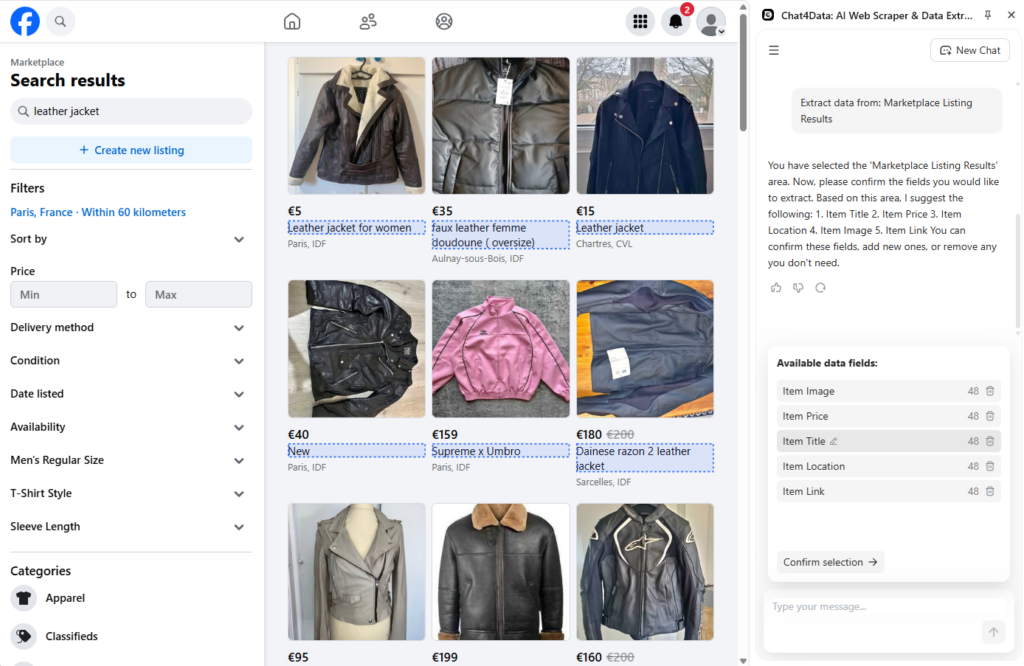
- Go to the Chrome Web Store and look up Chat4Data to download the extension. Click “Add to Chrome” to install the extension. Open Facebook and navigate to Marketplace. Start with your first search for the product you are interested in. I start mine with leather jackets. Then I start the Chat4Data extension on the side.
- I let Chat4Data scan the page for valuable data categories by simply typing the command in plain language. Chat4Data finds data fields in the search category and notifies me.
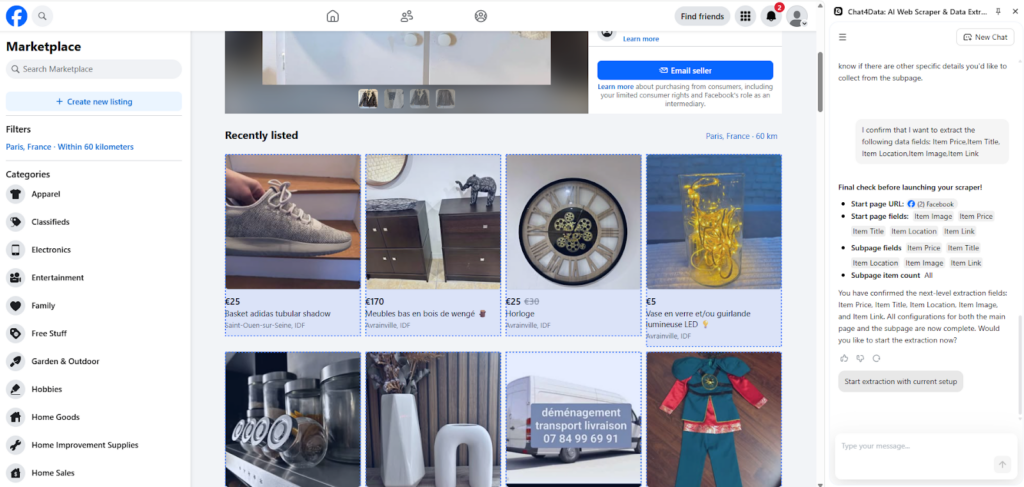
- Chat4Data offers to scrape detailed pages, meaning it will obtain more information from each product on the page. Chat4Data presents the final plan with all data fields it will extract.
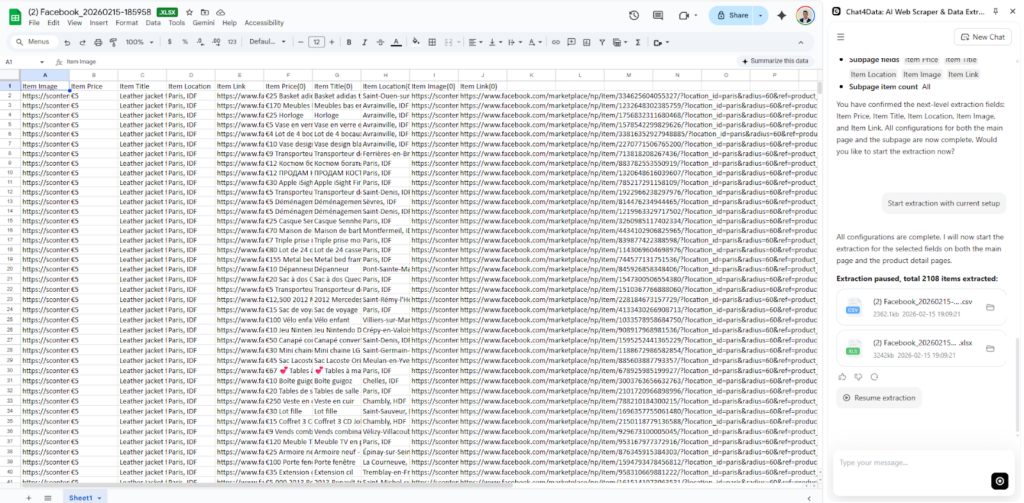
- Data is exported in CSV and Excel formats. I can now use it to analyze the marketplace at my own convenience further. Chat4Data offers retention up to 90 days (14 in the free tier).
BrightData
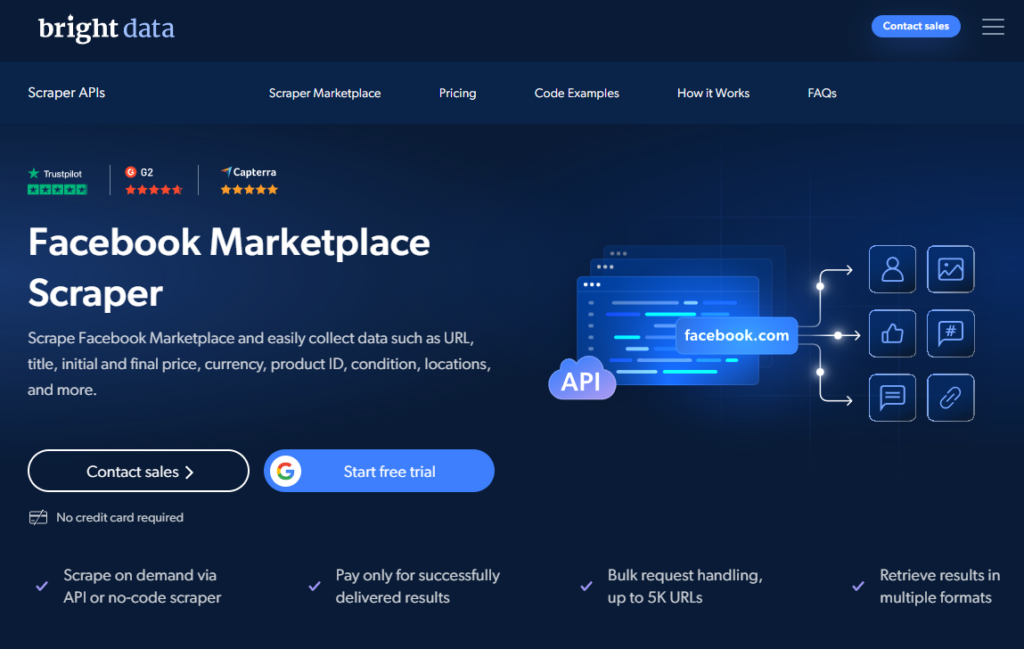
Bright Data is primarily known for its world-class proxy network, but it has also moved into the Facebook Marketplace scraping space with its “Web Scraper IDE” and “Data Collector.”
Key Features:
- Premade templates for popular websites
- Stable scraping detailed data at scale
Pros: Powerful features for large enterprises.
Cons:
- Steep learning curve.
- Customer support response times have been reported as slow for non-enterprise-tier users (according to community feedback).
Pricing: $499 per month (510K records) for bulk buy or $1.5 / 1k record for a pay-as-you-go model.
Personal rating: 2/5. Requires some development experience. Setup takes a while. Mostly targeted towards enterprise users.
User profile: Large enterprises and dedicated data teams that require massive, industrial-scale data extraction with premium proxies and are prepared for a high monthly cost and complex setup.
Practical tutorial for Bright Data:
- Navigate to the Bright Data platform and access the Web Scraper IDE.
- Select the pre-made Facebook Marketplace template from the available collectors list.
- Configure the scraper parameters: set the target search query (e.g., “vintage cameras”), choose the geographic location, and specify the desired output fields (price, description, seller info).
- Select a high-quality residential proxy network to ensure a high success rate and click ‘Run Now’.
- Monitor the real-time data collection status in the Data Collector dashboard and download the scraped data (JSON or CSV) once the job is complete.
Apify
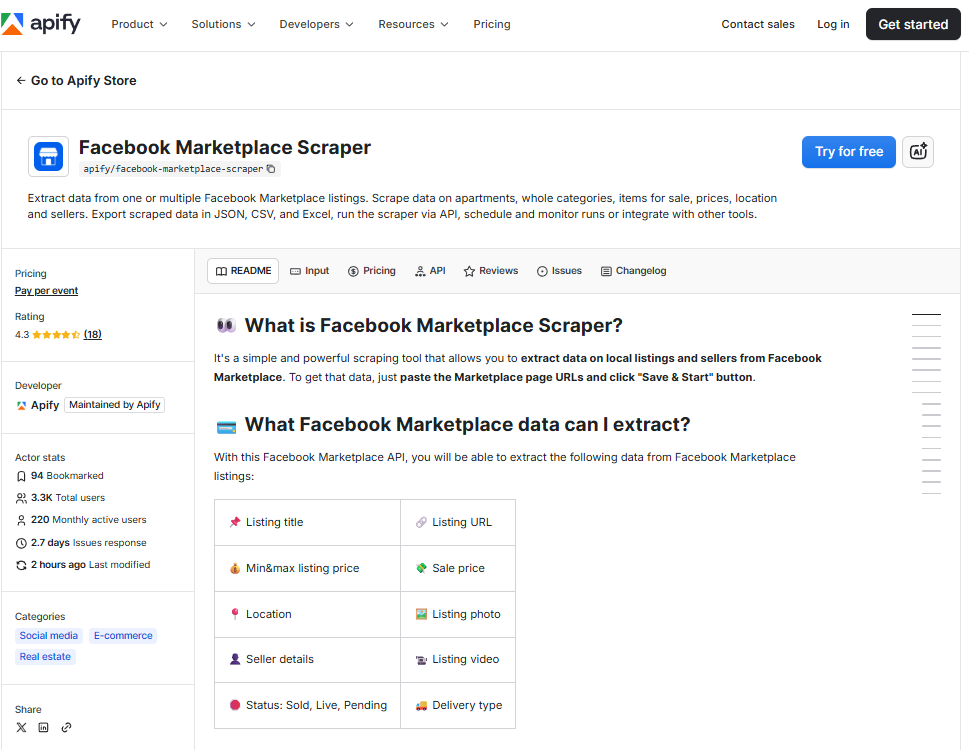
Apify is an API platform that offers premade templates for many websites, even created by community developers. Apify calls “actors” the tasks that scrape the data. It has dedicated templates for almost all possible scraping jobs, including Facebook Marketplace.
Key Features:
- API Integration: The scraping results can be easily integrated into your own apps, databases, or analytics tools via a simple API.
- Community-driven: Get access to a massive collection of pre-made scrapers for Facebook and other websites that are often made and updated by the community.
Pros:
- Developer-centric: Ideal for users with coding skills who need complete control over the process.
Cons:
- Maintenance: Apify “Actors” (apps) are sometimes left unmaintained for weeks. You have to wait for a developer to update the Actor when Facebook updates its anti-bot system. Chat4Data, on the other hand, updates its core algorithms from a single location.
- Steep learning curve: The platform is primarily designed for technical users.
Pricing: Free.
Personal rating: 3/5. It’s good for developers who want flexibility and API integration, but the community-driven “Actors” can sometimes be unreliable or require manual updates when Facebook changes its platform.
User profile: Developers who need a platform with a wide range of pre-built, community-driven scripts (“Actors”) and the flexibility to integrate results via API, but can manage occasional maintenance issues.
Practical tutorial for Apify:
- Navigate to the Apify Store and select the “Facebook Marketplace Scraper” Actor.
- In the Actor’s configuration, input your target parameters (e.g., search terms, maximum results).
- Click “Run” to execute the scraping job on Apify’s cloud servers.
- Once the run is finished, navigate to the “Storage” tab and download the extracted data in your desired format (JSON or CSV).
Practical tutorial for Apify:
If you’re looking for a simpler, code-based starting point before diving into a platform, check out Facebook Scraper Python.
Scrapfly
Scrapfly is a versatile API that developers can use to make their own scrapers. It provides a proxy pool and a headless browser solution, making scraping the Facebook marketplace as easy as making an API call.
Key Features
- Anti-Scraping Protection: Scrapfly’s proprietary technology bypasses advanced anti-bot systems by managing fingerprints and TLS handshakes.
- JavaScript Rendering: It fully renders the React-heavy Marketplace pages before returning the HTML to you.
- Extraction API: You can use AI to parse data from HTML automatically.
Pros & Cons
- Pros: Excellent anti-bot success rate; comprehensive developer documentation; supports Python and Node.js SDKs.
- Cons: Strictly a developer tool: no “point and click” interface. You must write code to integrate it. It is not a ready-made Facebook Marketplace website scraper, but it is the engine to build one.
Pricing: Starts at $30/month.
Personal rating: 4/5. Powerful anti-bot engine with a very high success rate for large-scale projects. However, building a custom scraper requires a significant coding investment, making it unsuitable for non-developers.
User profile: Professional developers and engineering teams looking for a powerful, anti-bot API solution to build a custom scraper from the ground up, valuing high success rates over a no-code interface.
Practical tutorial for Scrapfly:
- Obtain your API Key and install the Scrapfly SDK (e.g., Python) in your environment.
- Configure your scraping script to use the SDK and pass the target Facebook Marketplace URL.
- Ensure the ‘render_js’ feature is enabled in your API call to render the dynamic content.
- Execute the script; the API will return the fully rendered HTML, which you can then parse using libraries like BeautifulSoup to extract the final structured data.
Facebook Marketplace Scraper Extension
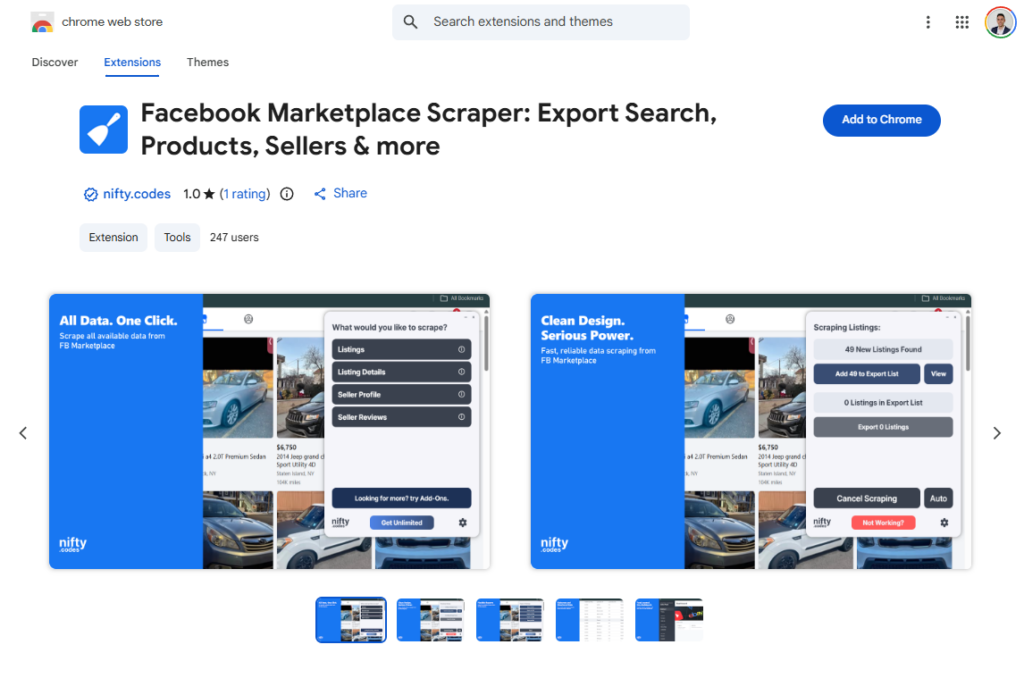
There are several dedicated extensions in the Chrome store, often with long, keyword-stuffed names. These are simple, single-purpose tools designed for casual users.
How It Works
Similar to Chat4Data, you install it and run it on a Facebook Marketplace page. It typically injects a “Download” button directly into the Facebook interface.
Pros & Cons
- Pros: It is very easy to use, and it often offers a free tier for light data usage. It is also specific to Marketplace, unlike generic scrapers.
- Cons: They lack Chat4Data’s AI adaptability, so they break a lot when Facebook changes. They do not often support advanced features such as deep crawling (clicking into each listing) or exporting large amounts of data without crashing the browser.
Using free browser extensions carries the risk of account suspension when scraping Facebook Marketplace, as it employs advanced anti-bot detection.
Pricing: Free.
Personal rating: 4/5. Very friendly to use, but it does not scale for large-scale scraping operations.
User profile: Casual users or hobbyists who need to scrape small, occasional batches of public data quickly and easily, but do not require speed, scalability, or high reliability.
Practical tutorial for Facebook Marketplace Scraper Extension:
- Go to the Chrome Web Store, find the extension, and click ‘Add to Chrome’ to install it.
- Navigate to Facebook Marketplace and perform your desired search query.
- Click the extension’s icon in the browser toolbar, or the dedicated ‘Download’ button it injects into the page, to start scraping the visible listings.
- Wait for the process to complete and download the extracted data as a CSV or Excel file.
Facebook Marketplace Scraper: Feature Comparison Table
In the following table, let’s compare all the tools in the key points we discussed:
| Feature | Chat4Data | Bright Data | Apify | Scrapfly | Scraper Browser Extension |
| Type | AI Browser Extension | Enterprise Cloud | Cloud Platform | Scraper API | Simple Extension |
| Target Audience | Analysts, SMBs, Non-coders | Enterprise, Large Teams | Developers | Developers | Casual Users |
| Personal rating | Easiest (Natural Language) | Hard (Requires coding) | Medium (Config-based) | Complex (API integration) | Easy |
| Setup Time | Instant | Weeks (Integration) | Fast | Days (Integration) | Instant |
| Maintenance | Zero (AI adapts) | High (Manual fixes) | Medium (Vendor fixes) | High (You fix code) | High (Wait for update) |
| Cost | Low / Subscription | $$$$ (High Monthly) | Pay per Usage | Pay per Usage | Freemium |
| Scalability | High (User-controlled) | Massive | High | High | Low |
| Risk of Ban | Low (Human simulation) | Low (Premium Proxies) | Medium (Cloud IPs) | Low (Premium Proxies) | Medium/High |
| Data Quality | High (AI Structured) | High | Variable | High | Medium |
| Cost per 1k Records | ~ $0.50 | ~ $1.50+ | ~ $1.00 | ~ $0.80 | ~ $0.05 |
| Scraping Speed | Very Fast (5-10 records/sec) | Very Fast (10-15 records/sec) | Medium (0.5-1 record/sec) | Very Fast (4-8 records/sec) | Slow (0.2 records/sec) |
| Success Rate | 95-99% (AI-Adapted) | 99%+ (Enterprise Proxies) | 80-95% (Variable) | 98%+ (Anti-Bot) | 50-70% (Fragile) |
How to Choose the Right Facebook Marketplace Scraper
Choosing the best Facebook Marketplace scraper for your business depends on ensuring the tool’s technical requirements and cost structure align with your goals. Use the following framework to help you choose the best option for your workflow.
- Technical Proficiency: Do you know how to code?
- Yes: Developer-focused tools like Scrapfly, Apify, or Bright Data give you the fine-grained control and API integration you need to make custom data pipelines if you know how to write Python or Node.js scripts.
- No: For non-technical users, Chat4Data offers an AI-powered natural language interface that eliminates coding. Alternatively, a Simple Browser Extension can work for very basic, manual tasks.
- Financial Strategy: What is your budget?
- High Monthly/Enterprise: Bright Data is designed for large-scale operations with significant budgets that require premium support and massive proxy networks.
- Pay-per-Usage: Apify and Scrapfly offer flexible, variable pricing, making them ideal for projects where data needs fluctuate month to month.
- Low/Fixed Subscription: Chat4Data offers a cost-effective subscription model accessible to SMBs and individual analysts.
- Operational Scale: What is the volume of data you need?
- Massive (Millions of rows): Enterprise solutions like Bright Data are built to handle industrial-scale extraction across global markets.
- High (Thousands to tens of thousands): Chat4Data, Apify, or Scrapfly can all reliably scrape large amounts of data while preserving data structure and bypassing anti-bot measures.
- Low/Casual: A Simple Browser Extension is sufficient for occasional use where speed and data cleanliness are lower priorities.
Conclusion
Manual data input is a thing of the past. A robust Facebook marketplace scraper is required to leverage Facebook’s hyper-local economic insights. Large-scale engineering teams can benefit significantly from developer APIs like Scrapfly and enterprise solutions like Bright Data, but these solutions are expensive and difficult to implement.
For the majority of companies, analysts, and marketers, Chat4Data is the ideal compromise. It enables you to scrape Facebook Marketplace with simple natural-language commands, fusing the simplicity of a browser extension with the power of generative artificial intelligence. You can concentrate on what really matters: the data. At the same time, it manages the intricacies of dynamic classes and anti-bot detection in the background.
Disclaimer
The tools reviewed in this article are evaluated on technical capability. Inclusion in this comparison is not an endorsement of any specific use case, nor a claim that scraping Facebook Marketplace complies with Meta’s Terms of Service or applicable laws in your jurisdiction.
This article does not constitute legal advice. Readers should consult qualified legal counsel before deploying any scraping tool for commercial purposes, particularly where GDPR, CCPA, or sector-specific regulations (real estate, automotive) may apply.
FAQs about Facebook Marketplace Scraper
- Can you scrape Facebook Marketplace?
Yes. Facebook Marketplace can be scraped, but its anti-bot systems make it technically challenging. You will need a dedicated tool, such as Chat4Data or a scraping API like Scrapfly, to do it reliably and at scale.
- What data can I extract?
A competent marketplace scraper may extract the following information: listing title, price, currency, location (city/state), category, description, seller name, seller ID, listing URL, image URLs, and status (available/sold).
- Is there a Python library to scrape Facebook Marketplace?
There are libraries on PyPI and GitHub. However, they are often broken. For a Python approach, utilize a scraping API like Scrapfly or a headless browser orchestrator like Playwright in conjunction with high-quality residential proxies.
- How do I scrape Facebook Marketplace listings for scrap metal specifically?
To scrape specific niches, such as Facebook Marketplace Scrap Metal, simply search the platform to find the appropriate results page URL. Then point your tool (such as Chat4Data or Apify) to the URL. The tool will run over the results for the specified search query.
- Is Scraping Facebook Marketplace Legal?
While Facebook’s Terms of Service strictly prohibit automated data collection, legal precedents like hiQ Labs v. LinkedIn suggest that scraping publicly accessible data likely does not violate the Computer Fraud and Abuse Act (CFAA). However, such actions remain a breach of contract with Meta. To mitigate risk, users should target only public data, maintain a low, human-like scraping volume, and strictly avoid collecting any private Personally Identifiable Information (PII).
 Try AI Web Scraper