
Google doesn’t want you scraping its search results. That is the harsh reality I learned a few years ago when my Python script ran into a wall of reCAPTCHA after just fifty requests. Today, finding a reliable Google SERP scraper isn’t about writing the best parsing code. It is about bypassing the most sophisticated bot-detection systems on the internet.
I tried out seven of the best tools over the past few years to see which could actually extract data from Google SERPs in 2026 with the highest quality. Scraping the Google SERP is essential for any business looking for rankings, competitors, or marketing purposes.
Quick Answer
The best Google SERP scraper depends on what you need:
- Chat4Data: A conversational AI agent. Describe what you want in plain English and its Chrome extension pulls the SERP data, no code required. Best for marketers and no-code users who want instant results.
- SerpAPI: The heavyweight for developers, with the deepest SERP feature coverage and easy API integration.
- Oxylabs: The enterprise standard for large-scale, highly localized data.
- ScraperAPI: A flexible mid-tier option for teams scraping Google alongside many other sites.
- Bright Data: Built for massive, compliance-heavy scraping at large corporations.
- SerpBear: Open-source and self-hosted, the pick for privacy and near-zero cost.
- Apify: Pay-per-result Actor, ideal for one-off batch research jobs.
Pick based on your technical comfort, the scale you need, and whether you want a no-code tool or an API to build on.
What Is a Google SERP Scraper?
A Google SERP scraper is a tool that automatically pulls data from Google’s search engine results pages (SERPs) at scale. It goes well beyond the ten blue links, capturing different data points, each with its own use:
- Organic titles, URLs, and descriptions — to see who outranks you and reverse-engineer why
- Featured snippets and People Also Ask boxes — to find the exact questions worth answering for position zero
- Local packs and knowledge panels — to check your local visibility and how Google describes your brand
- Paid ads and shopping results — to read what competitors bid on and how they price against you
- Keyword ranking positions — to measure how your SEO is actually trending over time
Most of today’s scrapers are AI-powered. Instead of leaning on brittle, pre-written CSS selectors, AI web scrapers use LLMs to read the page the way a person would and figure out which field is which on their own. The most advanced ones act as agents: they understand your instructions and scrape the data into a spreadsheet automatically.
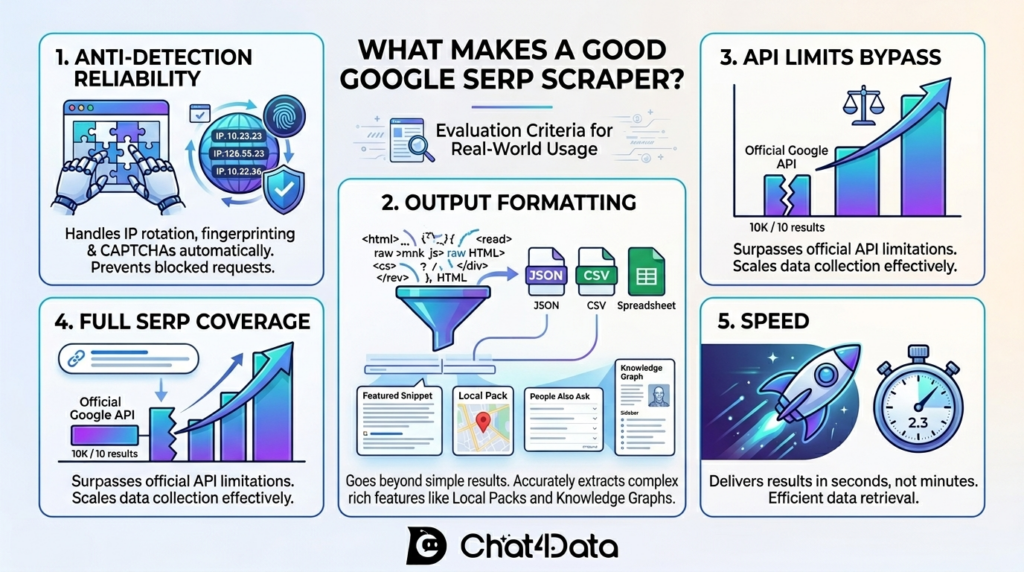
What Makes a Good Google SERP Scraper? (Key Criteria for SERP Data Extraction)
When I evaluate a Google search results scraper, I ignore the marketing fluff. A high success rate on paper does not mean anything if the tool can not handle a mobile query in a specific area. This is exactly what I was looking for when I tested:
- Anti-Detection Reliability: The tool must handle IP rotation, browser fingerprinting, and CAPTCHA solving automatically. If I have to debug a blocked request, the tool failed.
- Output Formatting: Raw HTML is useless to me. I need clean JSON, CSV, or direct spreadsheet integrations.
- Google Search API Alternative: The official Google API is incredibly limited (10K queries a day, capped at 10 results per query). A good scraper must surpass these limits.
- SERP Feature Coverage: Organic blue links are not enough. The scraper needs to accurately parse Featured Snippets, Local Packs, People Also Ask, and Knowledge Graphs.
- Speed: Getting data back should take seconds, not minutes.
The 7 Best Google SERP Scraper Tools
Let’s first talk about what each tool is and why it stands out, then we can compare key features and pricing plans.
Chat4Data
Chat4Data is a conversational AI agent for data collection. It is not like other API scrapers at all. As a lightweight Chrome extension, it combines AI and LLM with web scraping. No code users can easily get the data just by chatting.
What stood out to me: the sheer speed from intent to dataset. It works flawlessly as a Google SERP URL scraper. I pulled 500 localized SERP URLs straight into a Google Sheet in under three minutes, with no curl requests to set up or JSON objects to debug. It’s also a strong Webscraper.io alternative, since the AI handles the logic that would otherwise require manual CSS selector mapping.
Pros:
- Conversational interaction — describe what you want in plain English, no learning curve
- All data processed locally — nothing is sent to external servers, so your data stays private
- Handles complex pages — pagination, infinite scroll, detail pages, and one-level-deeper extraction
- Adapts to dynamic pages — keeps working even when Google changes its layout
Limitations: It is browser-based. If you need to hit 100,000 queries asynchronously overnight via a serverless function, this isn’t the tool for you. Octoparse is an enterprise-level tool with many templates, including a Google SERP scraper that can help with such a large-scale task.
Who it’s for: Marketers, SEO analysts, and data analysts who need structured SERP data immediately without bugging the engineering team.
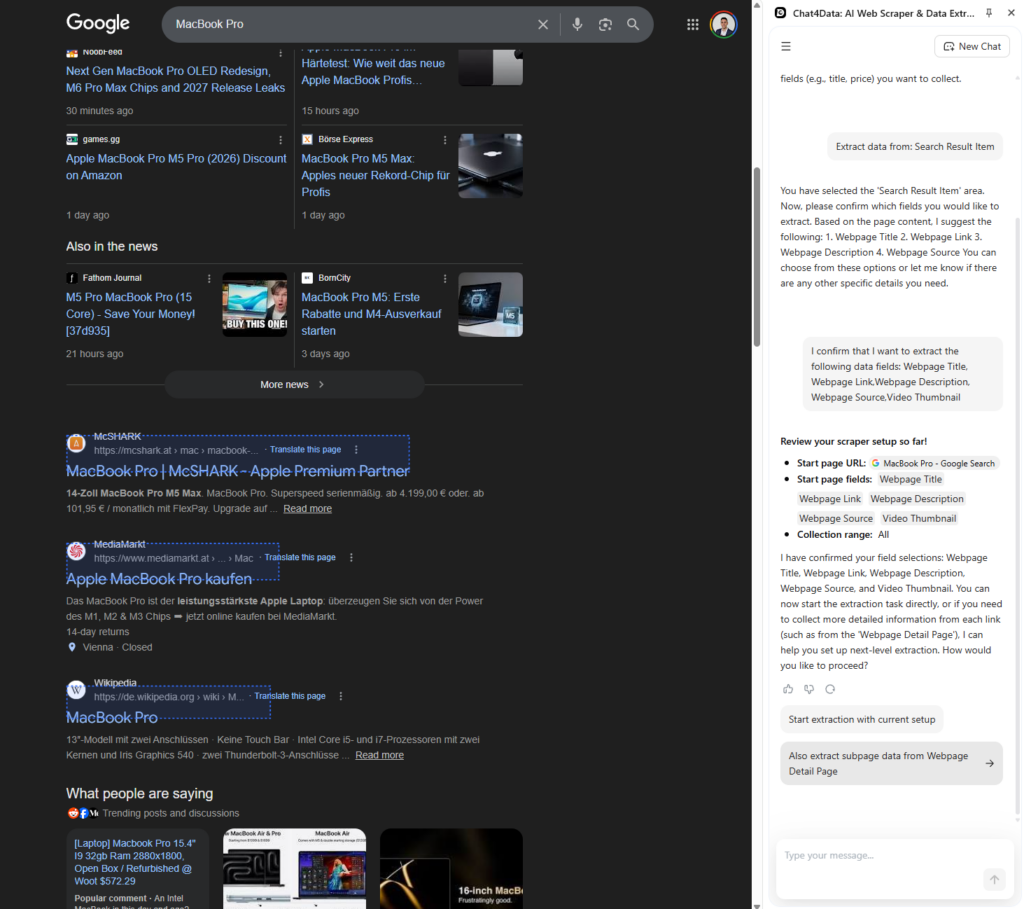
How to use Chat4Data for Google SERP scraping:
- Install the Chat4Data Chrome extension.
- Load the desired SERP in your browser. I will go with the “MacBook Pro” search on Google.
- Click the extension to let the AI automatically map the DOM structure.
- Chat4Data automatically recognizes different data fields and parses their contents using AI techniques.
- It is also possible to scrape subpages with Chat4Data. For each page it finds in the first round of scanning, it can enter and obtain more details. I will keep it simple for this tutorial and remain only with the first round of results.
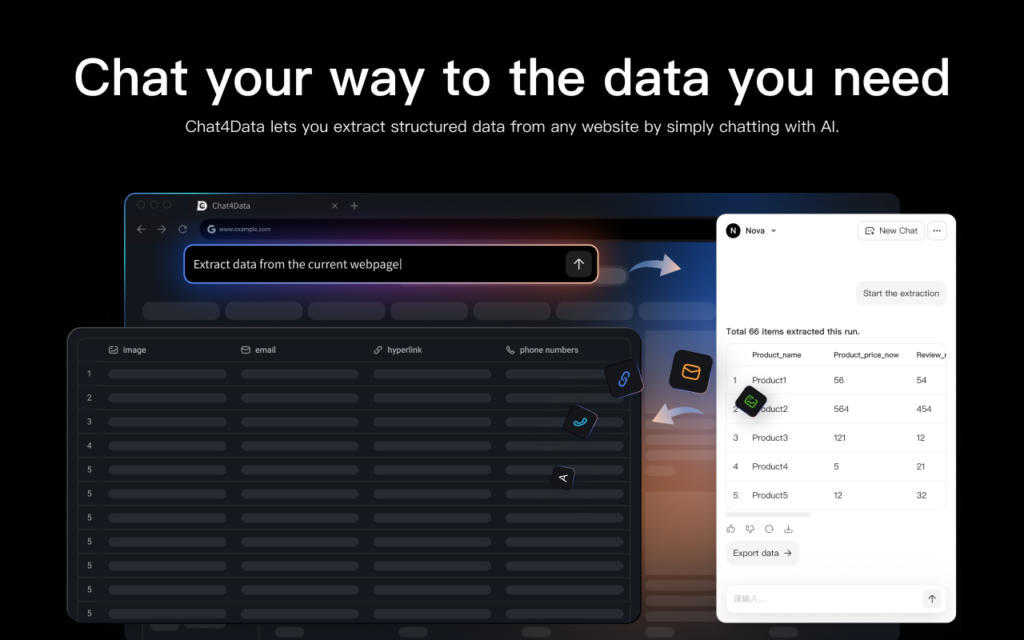
6. Data is ready to view and process in either CSV or Excel form. It is perfectly aligned with what I was looking for.
SerpAPI
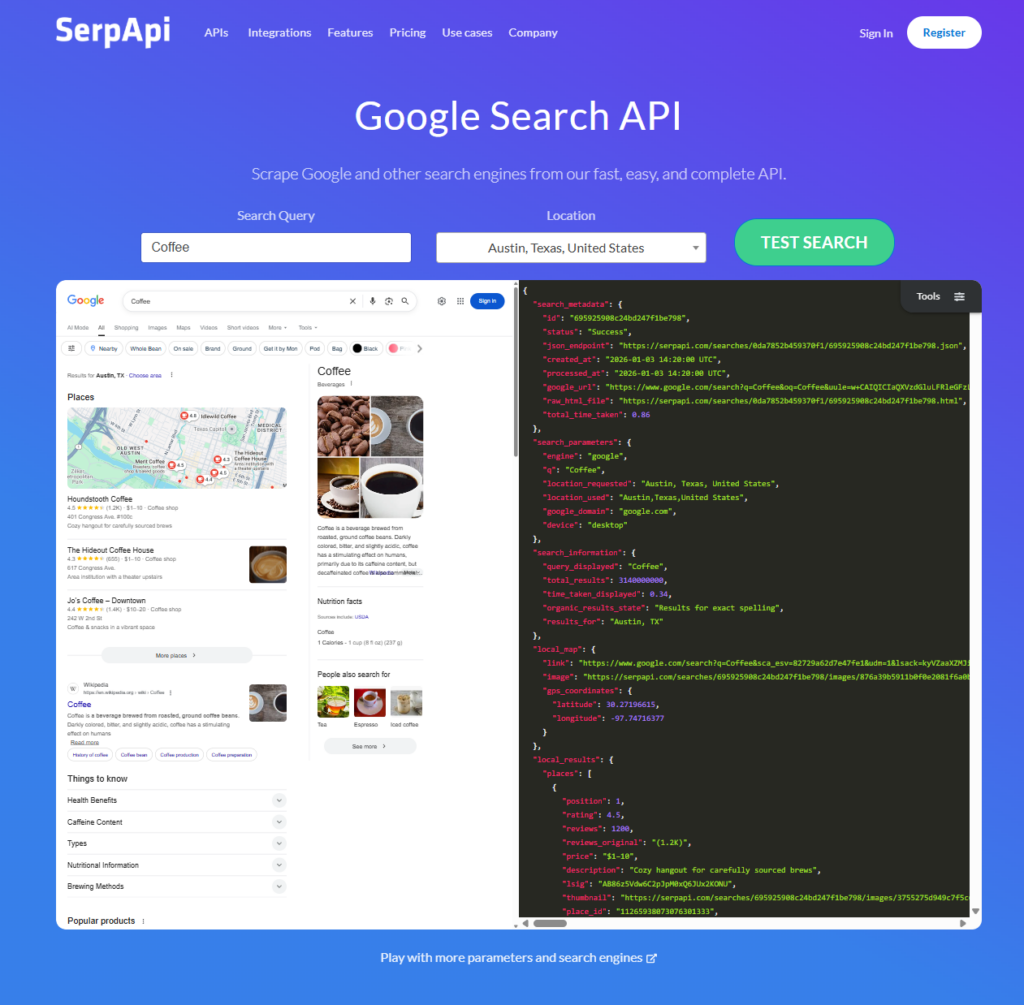
SerpAPI is the most widely used Google SERP API for developers, and for good reason. Send a query, get back structured JSON with 40+ parsed fields. In my tests, it caught edge case SERP features, carousels, and shopping ads that 4 out of 6 other tools missed.
What stood out to me: During my tests, it consistently caught edge-case SERP features, such as carousels and specific shopping ads, that other tools missed. Their documentation is thorough, and integration into Node or Python takes under an hour.
The limitation: Pricing scales very fast. The basic tier is fine, but if you are scraping millions of keywords, your monthly bill will reflect that premium service.
Who it’s for: Software engineering teams building custom SEO dashboards or internal rank-tracking software.
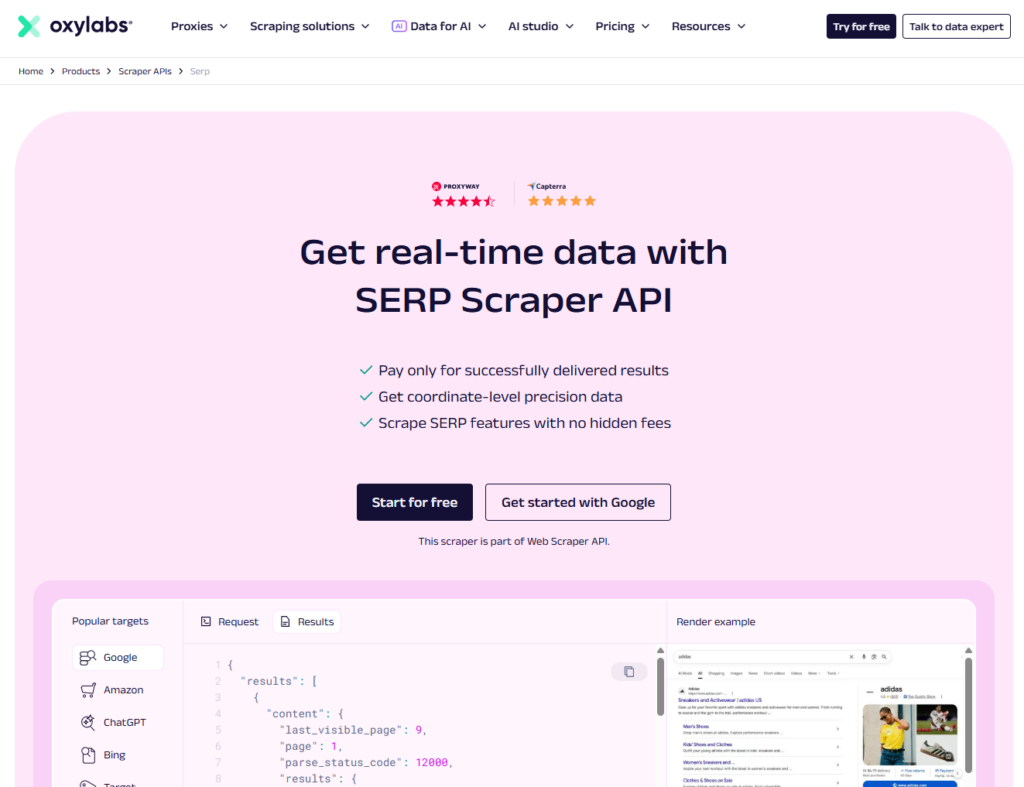
Oxylabs SERP Scraper API
Oxylabs dominates the proxy market with the widest residential IP coverage available. Their SERP scraper is an enterprise-grade infrastructure play. They leverage their massive residential proxy network to guarantee localized SERP results from virtually any city on Earth.
What stood out to me: The localization accuracy. I ran tests pulling results for specific zip codes in Tokyo and Berlin, and the localized map packs and organic results were spot-on. They also offer a 100% success rate guarantee, retrying failed requests under the hood before returning the JSON.
The limitation: It is overkill for small projects. The dashboard and onboarding process are clearly designed for enterprise clients buying huge volumes, not a solo dev running a weekend project.
Who it’s for: Enterprise data teams, large agencies, and aggregators who need millions of highly localized data points every day.
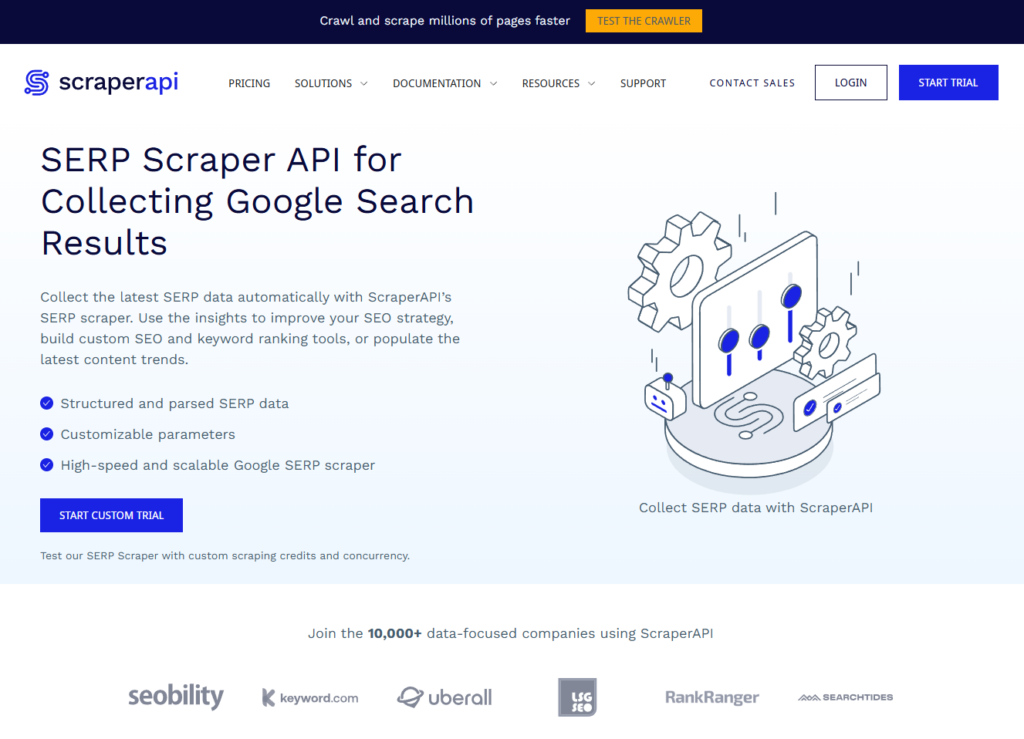
ScraperAPI SERP
ScraperAPI sits comfortably in the middle ground. It is technically a general-purpose web scraper, but it also has a dedicated endpoint optimized for search engines.
What stood out to me: The simplicity of the proxy rotation. You just add their API key to your standard HTTP request, and they handle the IP rotation and headless browser rendering automatically. It is a very flexible tool. You can ask for raw HTML if you want to write your own parser, or ask for parsed JSON.
The limitation: Because it is a generalist tool, its SERP parser isn’t as deep as SerpAPI’s when it comes to highly obscure SERP features.
Who it’s for: Growth hackers and mid-sized teams who need to scrape Google alongside a dozen other websites using the same proxy infrastructure.
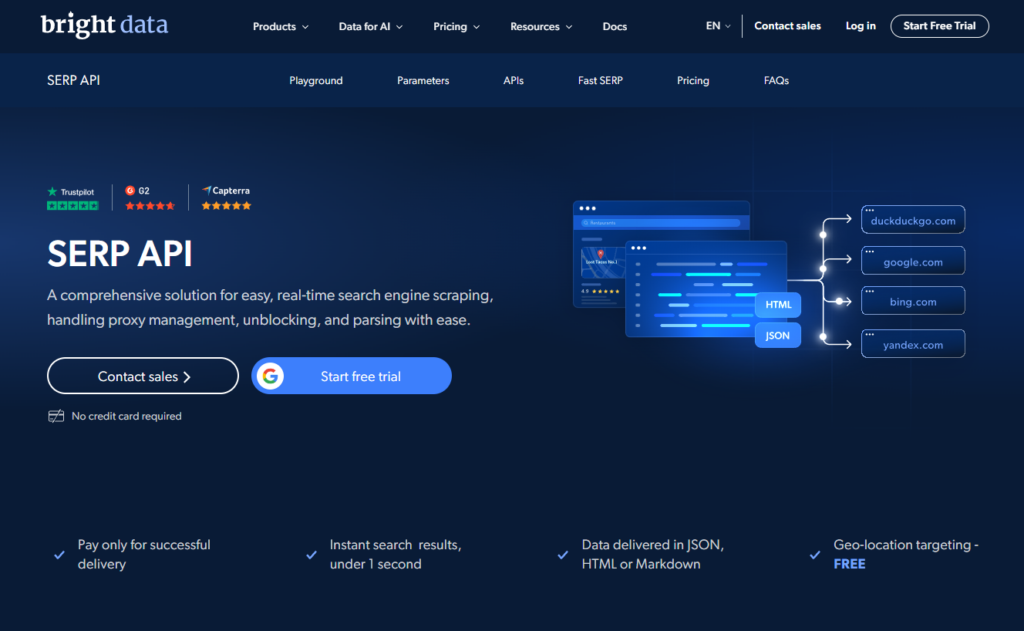
Bright Data SERP API
Like Oxylabs, Bright Data comes from the proxy side of the industry. Their SERP API is built on top of arguably the largest proxy network in existence.
What stood out to me: The compliance and volume capabilities. Bright Data is hyper-focused on ethical scraping and compliance, which is great if you are passing legal review at a large corporation. The tool can handle massive concurrent requests without breaking a sweat.
The limitation: The learning curve. Their dashboard is complex. Setting up a simple scraping job requires navigating through proxy zones, unlocking permissions, and configuring parameters that other tools abstract away.
Who it’s for: Corporate legal and data teams who require strict compliance standards and massive concurrent scraping power.
SerpBear
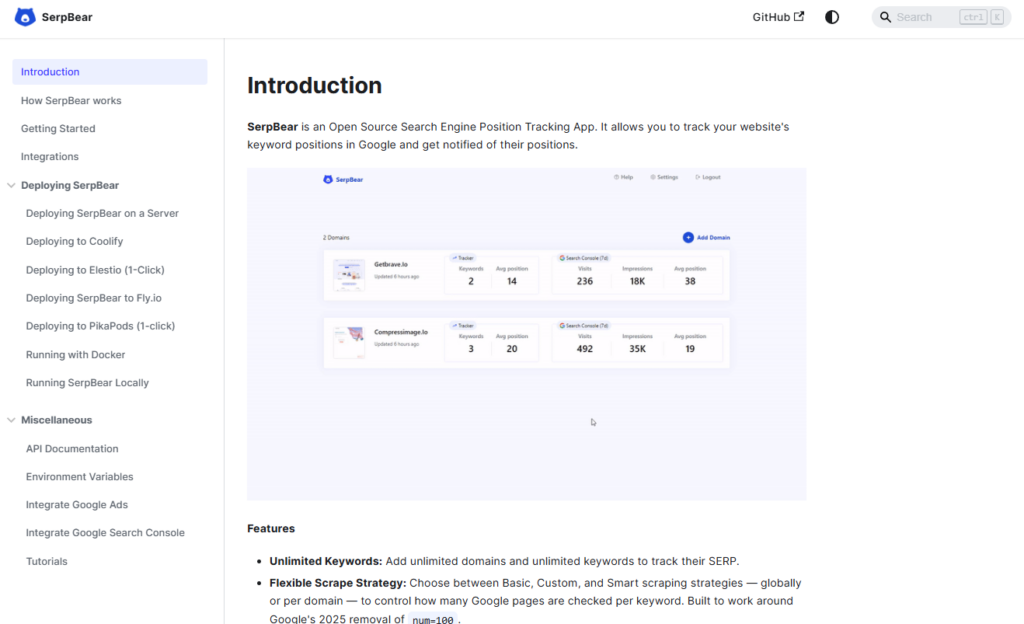
SerpBear is the wildcard on this list. It is an open-source, self-hosted rank tracker that doubles as a fully controlled SERP scraper.
What stood out to me: You own the infrastructure. Once deployed, it is a fantastic free google serp scraper. You feed it your own proxies (or rely on free ones if you like living dangerously), and it automatically scrapes Google to track keyword rankings over time. It stores everything locally in an SQLite database.
The limitation: Maintenance. If Google changes its DOM structure, your parsing breaks until the open-source community updates the repository. You also have to supply and pay for your own proxies to avoid immediate bans.
Who it’s for: SEO analysts who prioritize data privacy, and developers who want a self-hosted rank tracker without recurring SaaS costs.
Apify Google Search Scraper
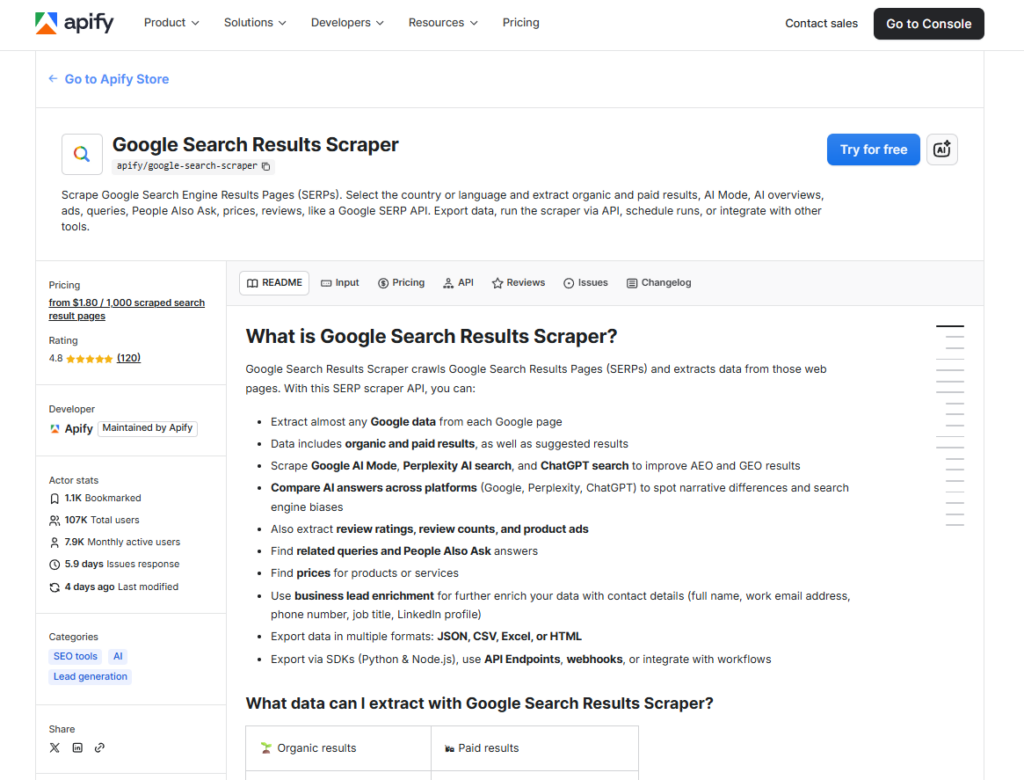
Apify is a cloud platform for web scraping that runs individual scripts called “Actors.” Their Google Search Scraper Actor is one of the most popular on the platform.
What stood out to me: The pay-per-result pricing model. Instead of paying a flat monthly fee for an API quota, you pay based on the compute time and data returned. You can configure the Actor via a nice web interface, hit Run, and get a clean CSV.
The limitation: Cold starts. Spinning up an Apify Actor can take a few seconds, making it less ideal for synchronous, real-time application requests compared to an always-hot API endpoint.
Who it’s for: Researchers and data scientists who need to run heavy, one-off batch scraping jobs rather than continuous pinging.
Google SERP Scraper Comparison: Features & Pricing at a Glance
| Tool | Type | Free Tier | Pricing Starts At | Best For | SERP Features Covered | Rate Limits | Success rates | Response speeds (in milliseconds) | Maximum concurrency limits |
| Chat4Data | Extension / AI | Yes | $29/mo | No-code data extraction | High | Generous | High | Near-instant | One page scraping at a time (Extension-based) |
| SerpAPI | API | 100 searches/mo | $50/mo | Developer integration | Very High | 100/mo (Free tier) | >99% | ~500ms | Varies by plan |
| Oxylabs | API | 1-week trial | $49/mo | Enterprise geo-targeting | High | Plan-based | 100% Guarantee | Varies by plan | Varies by plan |
| ScraperAPI | API | 5,000 API credits | $49/mo | General scraping mix | Medium | 5 concurrency (Start) | >99% | ~800ms | 5 (Starter plan) |
| Bright Data | API | Pay-as-you-go | $3/1k requests | Large-scale compliance | High | Unlimited | High | Varies | Unlimited |
| SerpBear | Self-hosted | Yes (100%) | Free (Proxy cost varies) | Self-hosted rank tracking | Low (Organic mostly) | Depends on your proxies | N/A (User-dependent) | N/A (User-dependent) | N/A (User-dependent) |
| Apify | Actor / Script | $5 platform credit | Pay per execution | Batch research jobs | Medium | Platform compute limits | Varies | Varies (Cold starts) | Varies by compute |
How I’d Choose the Best Google SERP Scrapers in 2026
Your choice comes down to infrastructure and your skill set.
- If you are doing budget research or running a solo project, deploy SerpBear and plug in some cheap datacenter proxies. It takes elbow grease, but it keeps costs near zero.
- If you are a developer building an ongoing rank monitoring app, just bite the bullet and pay for SerpAPI. The engineering hours you save by not writing your own parsers will easily cover the monthly subscription.
- Chat4Data is the best choice if you need data right away and do not want to open a terminal. The AI mapping and visual interface completely gets around the technical problems.
Conclusion
Google will keep making it hard to scrape. They will change their CAPTCHA, make small changes to their DOM elements, and block datacenter IPs very aggressively. For most serious projects, the days of making a scraper from scratch with raw Python libraries are over.
You need an abstraction layer. Start with Chat4Data’s free tier if you want results in minutes, or SerpAPI if you’re building a programmatic pipeline. Run a test query on your hardest keyword, the output format will tell you everything. Your first dataset is one click away.
Keep learning
If you’re scraping more than just Google, the core principles remain the same, but the tooling shifts.
- Trying to train a local AI model? You need a crawler that handles text differently. Check out my guide on the best website crawlers for LLMs.
- E-commerce data requires bypassing aggressive bot protection. Learn how to scrape Amazon reviews without burning your IP.
- For local business data like names, addresses, and ratings, see the best Google Maps scraper tools.
- To keep tabs on customer reviews, here are the best Google review scrapers.
- If you just need image files at scale, check the best Google image scrapers.
FAQs about Google SERP Scraper
1. What is a Google SERP scraper?
A SERP scraper is a program that automatically pulls information from Google Search Engine Results Pages. It does three things:
- Bypasses bot protections
- Parses the HTML
- Returns structured data
It is a far more capable option than the very limited official Google Search API.
2. Is it legal to scrape Google search results?
Generally yes. Recent legal cases, like hiQ v. LinkedIn, have made clear that scraping publicly available data is usually legal. A few things to keep in mind:
- It goes against Google’s Terms of Service
- Using scraped data commercially may require verification from Google; research use is normally fine
- Google can’t have you arrested for scraping, but it can pursue civil remedies like injunctions and damages
Always talk to a lawyer about your specific situation.
3. How do I scrape Google SERPs without getting blocked?
The core practices are:
- Send requests through residential proxies
- Rotate user-agent strings
- Handle headless browser fingerprinting
The easiest path is a managed tool like Chat4Data or SerpAPI that handles anti-detection for you.
4. Google SERP scraper vs the official Google Search API: which should I use, and how many results can I get?
This is the question behind most tool choices, so it’s worth combining:
- Result limits — Scrapers have no fixed cap; you can pull the full results page and paginate further by adjusting query parameters. The official API tops out at 10 results per query and 10,000 queries per day
- SERP feature coverage — Scrapers parse featured snippets, local packs, People Also Ask, and knowledge panels. The API returns only basic organic results
- Setup — No-code scrapers like Chat4Data need no code; the API requires an API key and code integration
- Cost — Scrapers run on a subscription or pay-per-result; the API stays limited even on paid tiers
- Practical note — most SEO use cases only need the first 1 to 3 pages, since results past page three see almost no clicks
Use the official API only for small, sanctioned queries inside an app. Use a scraper for rank tracking, competitor research, or any task where the API’s result cap or thin feature coverage is a dealbreaker.
5. Is there a free Google SERP scraper?
Yes, a few options:
- SerpBear — open source and 100% free to self-host (you supply your own proxies)
- SerpAPI — around 100 free searches per month
- Chat4Data — a free tier for light usage
6. Can I scrape Google SERP URLs specifically?
Yes. By default, almost all scrapers return the organic destination URLs. You can set up a tool like Chat4Data as a dedicated Google SERP URL scraper that skips titles and descriptions, sending a clean list of URLs straight to CSV.
7. What data can a SERP scraper collect?
Beyond the ten organic results, a good scraper pulls:
- Featured snippets (position zero)
- People Also Ask boxes
- Local packs and knowledge panels
- Ads and shopping results
Each is a separate extraction target, and coverage varies by tool. In our testing, SerpAPI caught the most edge-case features like carousels and shopping ads.
8. SERP API vs SERP scraper: which should I pick?
They suit different jobs:
- SERP API — returns structured JSON, handles all infrastructure, billed per query. Best for production pipelines
- No-code scraper — flexible, lower cost for one-off or browser-based work, no code. Best for research
- Custom script — most control, but you build and maintain everything yourself
 Try AI Web Scraper